
Future 2050: The World Through the Lens of Science
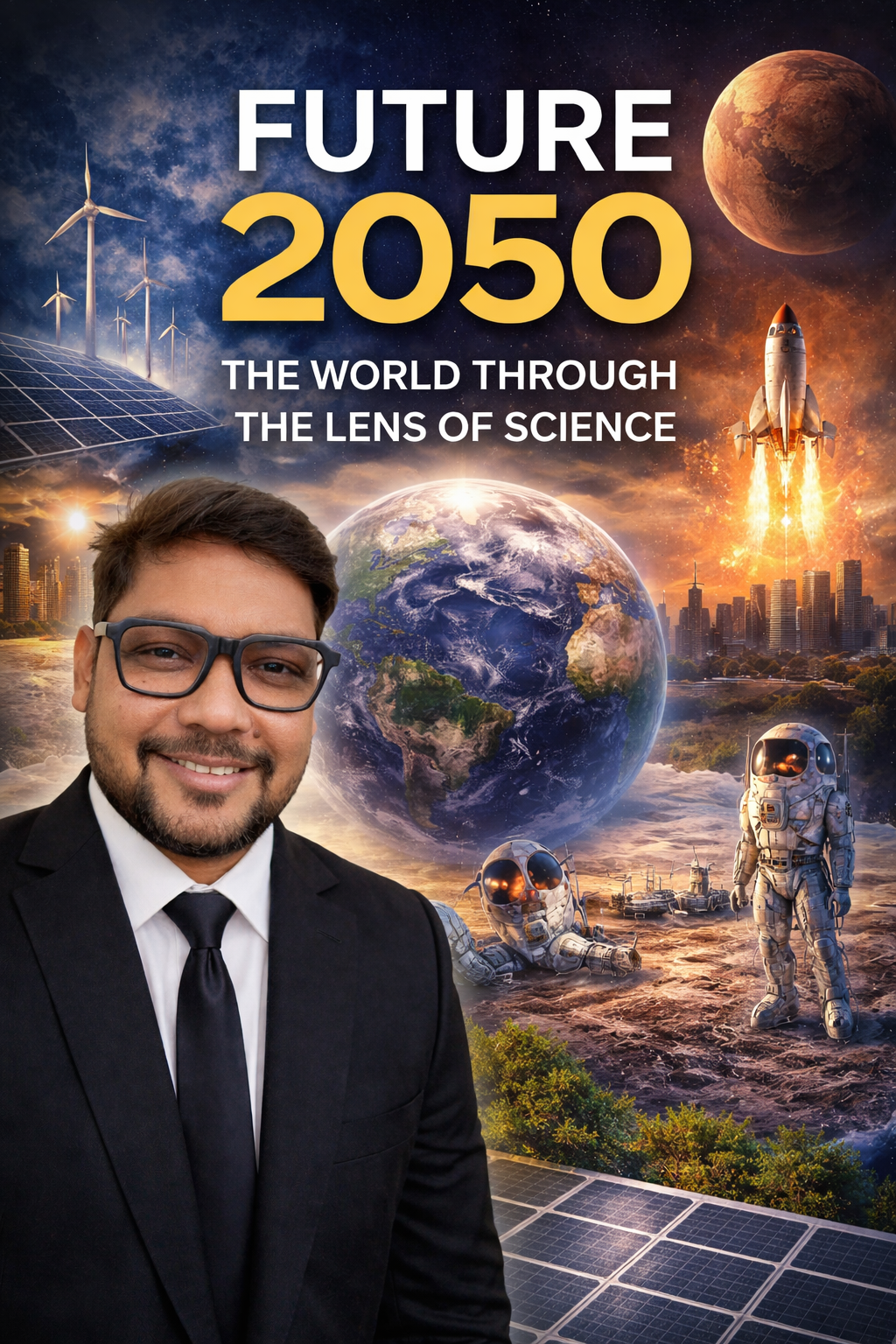
The year 2050 is no longer a distant point on the horizon. From laboratories and observatories to data centers and city streets, science is quietly shaping what that future may look like.
1. Human Life and Health: Longer, Smarter, Assisted
By 2050, medicine is expected to shift from treatment to prediction and prevention. Personalized medicine will dominate healthcare. Genetic profiling may allow doctors to predict diseases decades before symptoms appear.
AI-assisted diagnostics will become routine, reading scans and lab results with higher accuracy than humans.
Human lifespan may extend further—not necessarily through immortality, but through healthier old age. Diseases like certain cancers and genetic disorders could become manageable conditions rather than fatal ones.
The ethical debate will intensify: Who gets access to advanced healthcare, and at what cost?
2. Artificial Intelligence: From Tool to Partner
By 2050, Artificial Intelligence will no longer be limited to software assistants or automation tools. AI systems may design drugs, materials, and even scientific theories.
Human–AI collaboration will redefine jobs rather than eliminate them entirely.
Education may shift from memorization to problem-solving, creativity, and ethics, as machines handle routine cognitive tasks.
The central question will not be “Can AI think?” but “How much decision-making should we allow it?”
3. Energy and Climate: Survival Through Science
Climate change is the defining challenge of the 21st century, and by 2050, science will determine whether humanity adapts—or suffers.
Renewable energy (solar, wind, hydrogen) is likely to dominate global power generation.
Battery technology and energy storage will decide how reliable green energy becomes.
Climate engineering, such as carbon capture or atmospheric cooling, may be attempted as a last resort.
Science will not just power homes—it may decide the habitability of entire regions.
4. Space Science: Humanity Beyond Earth
By mid-century, space may no longer be the domain of a few astronauts.
Permanent or semi-permanent human presence on the Moon is plausible.
Mars exploration may move from robotic missions to early human settlements.
Space-based industries—satellite manufacturing, space mining, and research labs—could emerge.
Space science will redefine humanity’s identity: Are we a planetary species, or a multi-planetary one?
5. Cities, Work, and Daily Life
The science of urban living will transform everyday experiences.
Smart cities will use sensors and AI to manage traffic, water, energy, and waste.
Physical offices may shrink as remote and hybrid work become permanent norms.
Robotics may handle dangerous or repetitive labor, while humans focus on design, care, and creativity.
The challenge will be social, not technical: ensuring dignity, employment, and inclusion in a highly automated world.
6. Biotechnology and the Redefinition of Life
Advances in biotechnology may blur the line between natural and artificial life.
Gene editing could eliminate inherited diseases—but also raise fears of “designer humans.”
Synthetic biology may create new organisms for medicine, agriculture, and environmental repair.
Food production could shift toward lab-grown meat and climate-resilient crops.
By 2050, humanity may gain the power not just to understand life—but to redesign it.
7. Ethics: The Greatest Scientific Challenge
Ironically, the biggest challenge of 2050 may not be technological, but moral.
Science will give humanity unprecedented power, but: Who controls that power?
How is it regulated across nations?
Can ethics evolve as fast as innovation?
Without ethical frameworks, scientific progress could deepen inequality instead of reducing it.
Conclusion: 2050 Is a Choice, Not a Destiny
The technologies of 2050 are already being developed in today’s laboratories, universities, and startups. Whether they lead to a more just, sustainable, and intelligent world depends on decisions made now.
The future is not something we enter. It is something we create—experiment by experiment.
By 2050, science will not ask whether humanity can change the world. It will ask whether humanity chose to change itself wisely.
—-+++—-
MANOJ ADHYAYI, Sr AI PROJECT MANAGER