Republic Day: Lesser‑Known Stories You May Not Know
1️⃣ 26 January — A Date Chosen With Purpose
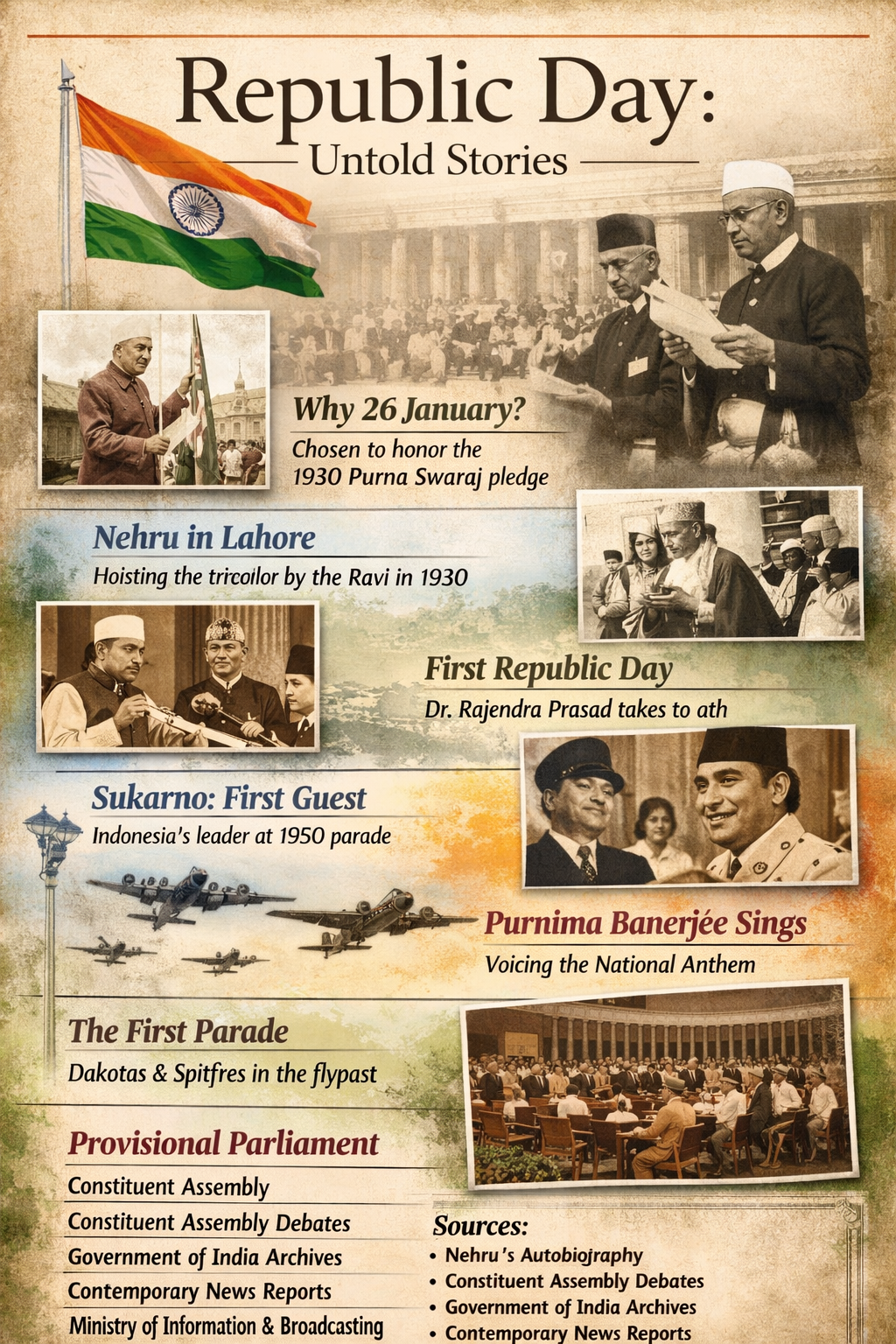
India did not randomly choose 26 January. The date deliberately recalls 26 January 1930, when the Indian National Congress declared Purna Swaraj (Complete Independence). By enforcing the Constitution on this date in 1950, the Republic formally fulfilled a promise made two decades earlier.
2️⃣ The Tricolour Was Hoisted Before Freedom
Long before independence, the national flag was publicly hoisted at Lahore on the banks of the Ravi on 31 December 1929. From 1930 onward, 26 January was observed across India as Independence Day — a quiet rehearsal for the Republic to come.
3️⃣ What Happened on the Morning of 26 January 1950
At 10:18 a.m., India formally became a republic. The Governor‑General read the proclamation, the Constitution came into force, and Dr. Rajendra Prasad took oath as India’s first President. There was no midnight drama — only a dignified constitutional transition.
4️⃣ Indonesia’s Sukarno: The First Republic Day Guest
India’s very first Republic Day Chief Guest was President Sukarno of Indonesia. This early gesture reflected India’s commitment to Asian solidarity and post‑colonial cooperation — a tradition that continues to define Republic Day diplomacy.
5️⃣ The First Parade Looked Very Different
The 1950 Republic Day parade featured World War II‑era aircraft such as Dakotas, Harvards and Spitfires. The display reflected a nation transitioning from colonial forces to an independent military identity.
6️⃣ A Forgotten Voice Behind the Anthem
When the Constituent Assembly concluded its historic session, freedom fighter Purnima Banerjee led the singing of the National Anthem — a moment recorded in official proceedings but rarely remembered.
7️⃣ The Framers Became the Lawmakers
After adopting the Constitution, the Constituent Assembly transformed into India’s Provisional Parliament. The same leaders who framed the Constitution governed the nation until the first general elections.
[M K Sr AI PROJECT MANAGER]